HomeBooksMediaKnowledge BaseCommunityContact Us

Ebb and flow hydroponic system

1. Introduction

Is a high tech garden more productive than a low-tech garden? What does “high tech” mean? Does it mean that you grow with the aid of lots of cool little gadgets in a tricked out automated hydroponic (soil) system? Or can you achieve the same yields as the great big high techie gardens by using the advanced technology provided by years of research, but in the form of a low-tech garden? I have seen both kinds of gardens and let me tell you here and now, I will put my pesos on the simple garden every time.

The plants don’t care about the technology level or the expense of the garden. All plants care about is that their needs are met to the max 24/7. To demonstrate a simple easy low-tech ebb and flow hydroponic system that gives plants and growers what they want, I took a look at Dutch gardens that were set up and maintained by an expert with lots of high tech, hands-on experience.

John worked as an engineer for a big agricultural manufacturer and spent much of his time visiting greenhouses and solving problems. After 15 years of working in this capacity, he was burned out with the corporate world and decided to put some of the knowledge to work and grow some good dope.

According to John, “Coming from an agricultural background, I tend to look at everything like I’m running a commercial greenhouse. The house could be growing thick-walled red peppers, long English cukes or a crop of Northern Lights, it is all the same to me. Each crop and variety has its own needs and peculiarities. All you have to do is learn to give them what they want and production rocks and rolls!”

Beautiful bed of buds shows the success of a simple ebb and flow garden.

Buds are well developed after using PK 23-24 from Canna.

2. What constitutes high tech?

We are able to study how plants use light, air, water, heat and a substrate to manufacture food and grow. We can apply this technical knowledge precisely with the help of some simple instruments: pH meter, EC meter, water meter, thermometer, hygrometer and light meter. As their names imply, each instrument meters or measures a factor that controls plant growth. These high tech devices are indispensable when monitoring atmospheric conditions in grow rooms and hydroponic systems that support plant growth.

The next level of technology is the application of information collected by meters. This is where the expensive high tech devices come into play. Depending upon your budget, you can choose from a menagerie of different gadgets to control the pH and EC of a nutrient solution and growing medium, the temperature of the nutrient solution and the temperature and humidity of the air. Once the lighting system is set up properly with the help of a light meter, little adjustment is necessary. This is the stage where too many growers get bogged down in technical details and forget the goal: grow a heavy harvest of the best dope possible.

For example, I met a grower who was rambling on and on about the cool system he is building. “I am going to set up a video camera so that I can monitor my girls when I’m snowboarding or on vacation. I don’t have to be in the room to know what is going on there. It is all monitored automatically and I will be able to see everything from my laptop and I can change the pH with a few keystrokes on my cell phone while I’m on the chair lift.”

His high tech room consisted of 8, 600w HP sodiums in a NFT hydroponic system. He spent months setting up his garden and fine-tuning it. After three crops, he got the maintenance schedule down to a few minutes a day. He was harvesting 0.4 grams-per-watt of light in the flowering room every 30 days (4800w x 0.4 grams = 1920 grams/28 = 68.5 ounces every 30 days). But rather than increasing yield to 0.5 GPW by applying technology, his desire was to concentrate on technology that made his life easier rather than that of his plants.

A simple ebb and flow garden is quick, easy and economical to set up because it does not need an expensive high-pressure pump and with a lot of irrigation tubes and manifolds. The fewer moving parts the less there is to go wrong. Sure you can buy a big expensive system, and it will probably work very well, but you have to pay for it. You can pay for a simple ebb and flow system with the proceeds of the first crop and still have plenty of smoke. Big expensive systems do not grow any more weed, they just costs more.

I met another grower that was having a lot of trouble growing with a makeshift hydroponic system he made from instructions he saw on the Internet. He was harvesting only 0.3 grams-per-watt of light every 60-day crop. John helped him set up with a simple ebb and flow system and he now harvests 1 to 1.2 grams per watt every 60-day crop. Once again, simplicity is the answer.

But if you still have a hankering for some high-tech stuff check out: the WMC, http://grodan.com/sw11984.asp. It measures water content, EC, temperature, and you can download this information onto your computer where you can produce graphs of water content, EC and temperature of up to 2300 measurements. You can also find lots of other great high-tech stuff at www.greenair.com.

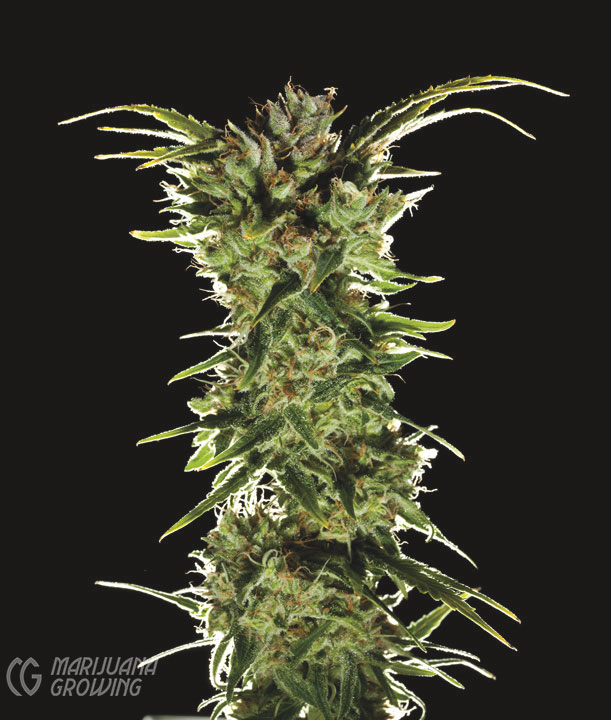
Close up of the variety Citral, a heavy producer.

Check out this resin-frosted Citral bud, proof that loading up a robust clone with PK 13-14 really makes them swell.

3. The basics of how the system works.

Table Setup

Flood and drain systems are simple by design and very easy to construct.

To make an ebb and flow system, you need to make sure the floor or table is completely level. If it is not completely level, you must make it level. The easiest way to level a floor is to replace it. Set a low profile cinder block in each corner of the room. Place a 2 x 6 on each one of the blocks to form a rectangle around the room. Set a level on one of the beams. Raise one end with a small wooden wedge until it is level. Proceed with the next beam and the next until they are all level. Secure 2 x 4 cross members on the secured 2 x 6 beams. Cover the 2 x 4s with 0.5 or 0.75-inch plywood.

Build a small 6-inch lip around the edge of the garden and line the garden with heavy duty pond liner or other thick plastic. Pond liner is difficult to puncture and comes in rolls of 4 and 6 meters wide and 200 microns thick. Fold plastic up and around lip and staple in place. Remember, this thing has to hold water!

Page 1 | 2 | 3


Press Releases

Marijuana Grow Basics Media

Marijuana Grow Basics - Request Book for Review

Jorge's Photos

Jorge's Event Calendar

Marijuana Horticulture: The Indoor/Outdoor Medical Grower’s Bible Blurbs

Jorge Cervantes’ Biography

Jorge's Articles

Media Collaborations

Jorge Cervantes Interview by Chris Simunek

Jorge Cervantes Interview by Skip Stone

How to Interview Jorge?


© Jorge Cervantes 2006-2009
Rights and Disclaimers